Explore the nine supplied historical museum posters, listen to the locally generated English audio guides, and practise three questions after each chapter. This is a lightweight 2D alternative with no 3D rendering.
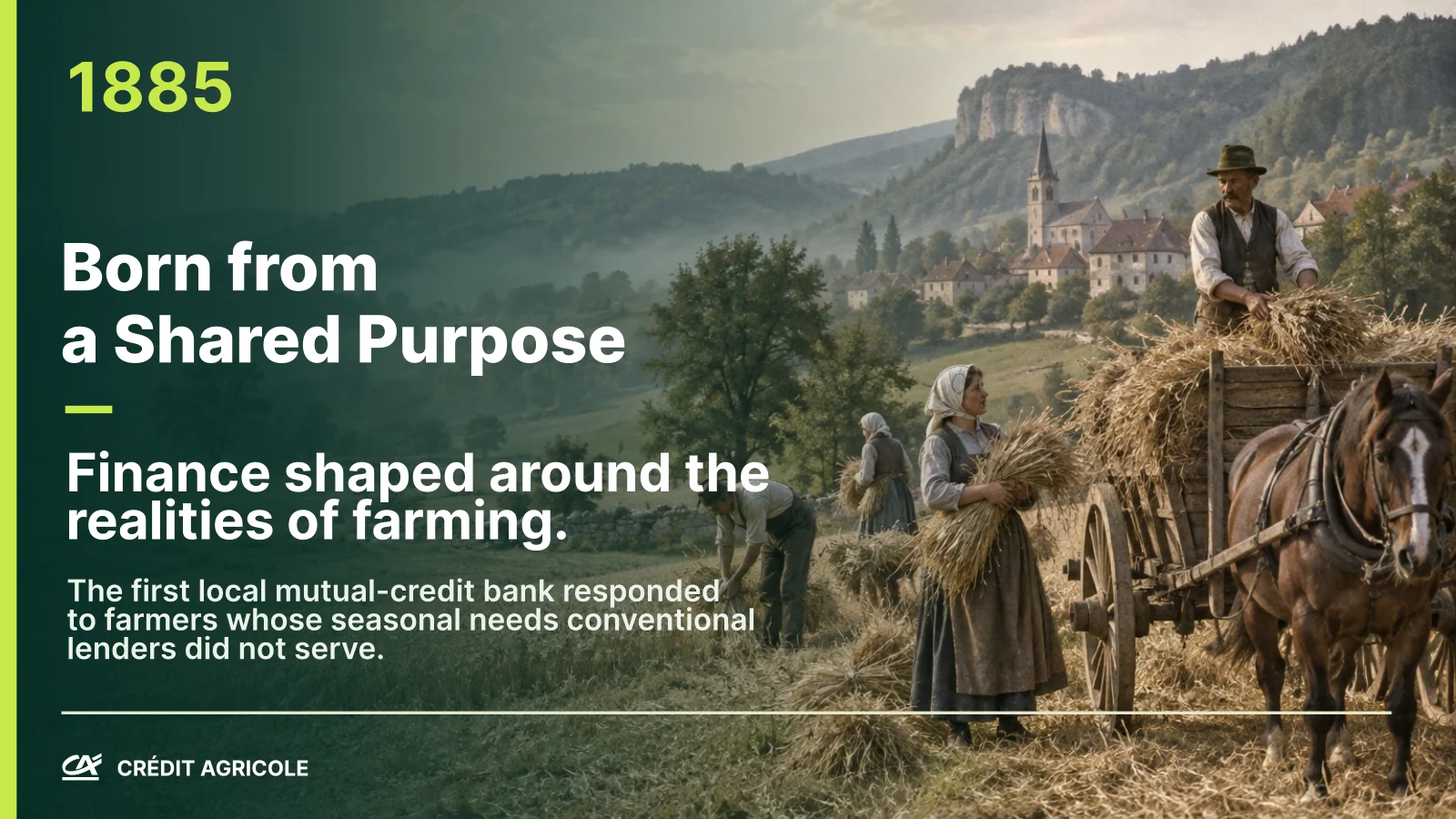
Welcome to your Crédit Agricole onboarding journey. This is chapter 1: A Bank Born from a Problem. Look at the landscape in front of you. In the late nineteenth century, French farming was essential to everyday life, but access to finance was not designed around farmers' needs. Most established banks operated in towns. Farmers needed money before the harvest, while much of their income arrived only after crops or livestock were sold. A standard short repayment schedule did not always fit this rhythm.
In the Jura, two local figures, Alfred Bouvet and Louis Milcent, supported a different approach. On 25 February 1885, the first local agricultural mutual-credit institution was established in the district of Poligny, with its headquarters in Salins-les-Bains.
The important innovation was not a luxurious building or a new financial product. It was the starting question: what kind of finance would actually help these people succeed? Members pooled resources and organised lending around a shared local purpose.
The name Crédit Agricole means agricultural credit. It preserves the memory of the original community the institution was created to serve. As you walk to the next poster, notice how a solution developed for one group of people became the foundation of an entire banking model. As a new colleague, consider what this moment teaches us about understanding customer needs, acting responsibly, and building trust. You can now explore the poster's three questions.
Practice the three questions1. Why did farmers need a different lending approach?
They wanted loans that would never have to be repaid.
They were prohibited from owning businesses.
They needed finance adapted to seasonal cash flows and production risks.
Show answer & explanation
C. They needed finance adapted to seasonal cash flows and production risks. — Agricultural income and expenditure followed seasonal patterns that city-focused banks often did not accommodate.
2. What is the most important idea behind the 1885 initiative?
Serve the financial needs of a community that was poorly served.
Open the largest bank building in France.
Replace all farms with industrial businesses.
Show answer & explanation
A. Serve the financial needs of a community that was poorly served. — The original design responded to a real economic need before pursuing scale.
3. What does the name Crédit Agricole reveal about the Group?
It was founded as an insurance company.
Its historical purpose was agricultural credit.
It has never served anyone except farmers.
Show answer & explanation
B. Its historical purpose was agricultural credit. — The name records the origin; later services expanded far beyond agriculture.
CHAPTER 02 · 1894–1899 | The cooperative foundation
The Power of Acting Together
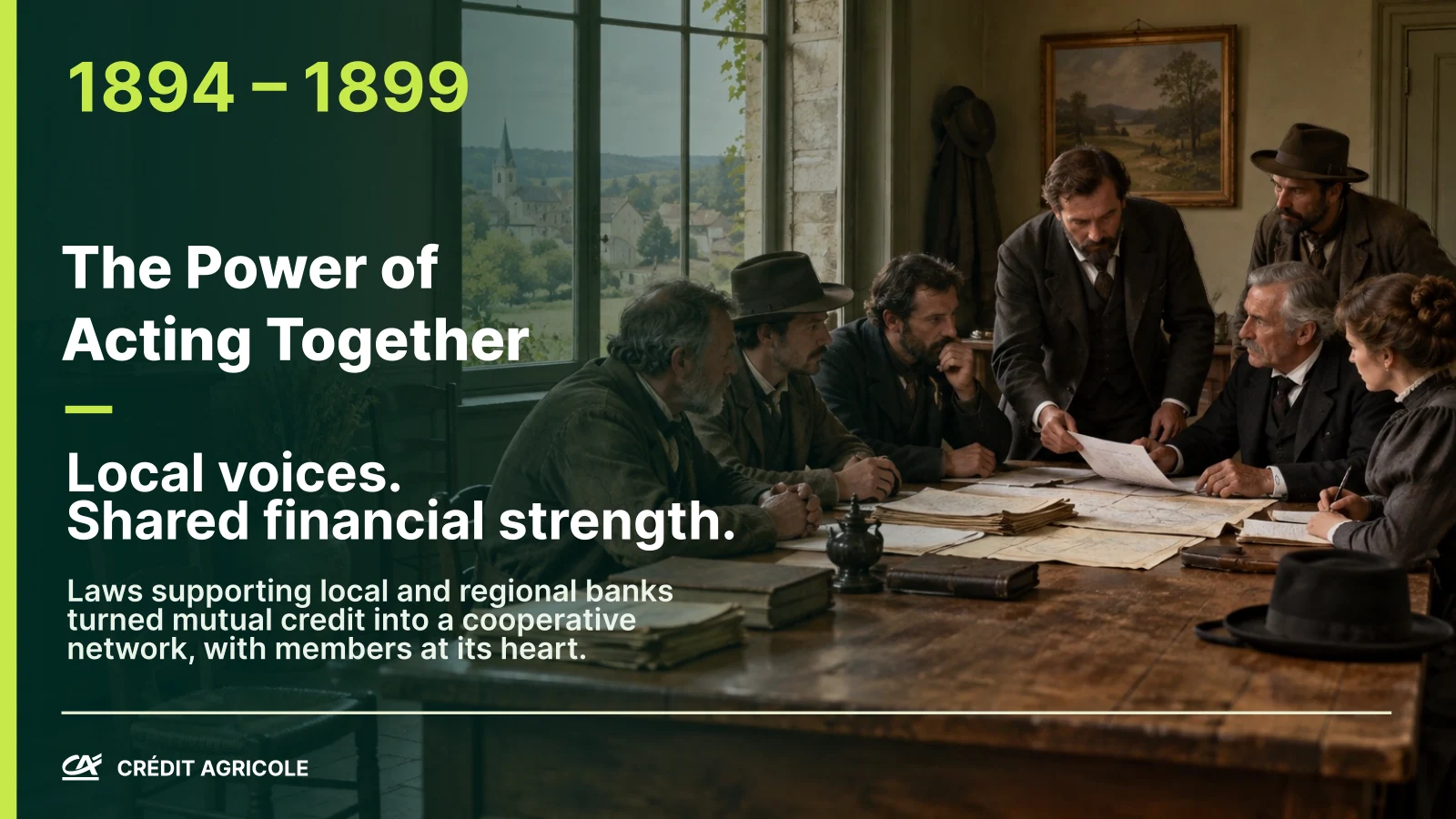
Welcome to your Crédit Agricole onboarding journey. This is chapter 2: The Power of Acting Together. The first experiment was promising, but one local institution could not solve every farmer's financing problem. There were two related challenges. Local members could organise around shared needs, yet the funds they collected were often too limited for all the loans requested. And a network of independent communities also needed ways to cooperate at a larger scale.
The 1894 law encouraged local Crédit Agricole institutions across France. The 1899 law then established regional banks that could bring local institutions together and distribute additional funding.
This created a distinctive balance. Decisions and representation began close to the people using the bank. Regional organisations provided financial capacity and coordination. National support made broader growth possible.
An important cooperative principle is one member, one vote. This means the ability to participate in governance is not simply a reward for contributing the largest amount of capital.
The takeaway is not that every customer now runs a bank. It is that Crédit Agricole's roots are different from a bank founded solely by outside investors. Its cooperative identity is linked to local participation, relationships and long-term responsibility. Keep that idea in mind; it will reappear in the Group's present-day purpose. As a new colleague, consider what this moment teaches us about understanding customer needs, acting responsibly, and building trust. You can now explore the poster's three questions.
Practice the three questions1. Why were regional banks added to the local-bank system?
To stop financing agricultural activity.
To pool capacity and coordinate financing beyond what a local institution could provide.
To eliminate all local participation.
Show answer & explanation
B. To pool capacity and coordinate financing beyond what a local institution could provide. — Regional organisation made the local model scalable without losing its community roots.
2. Which statement best expresses cooperative governance?
The biggest borrower automatically makes all decisions.
Only the national government can vote.
Members have a voice that is not simply proportional to wealth.
Show answer & explanation
C. Members have a voice that is not simply proportional to wealth. — The mutualist principle of one member, one vote distinguishes the tradition.
3. What is the central organisational lesson of this poster?
Combine local knowledge with shared resources at a wider level.
Local knowledge is unnecessary when institutions grow.
A successful bank should never change its structure.
Show answer & explanation
A. Combine local knowledge with shared resources at a wider level. — The design preserved proximity while improving financial reach.
CHAPTER 03 · 1900s–1920s | Organising for scale
Local Roots, a National Backbone
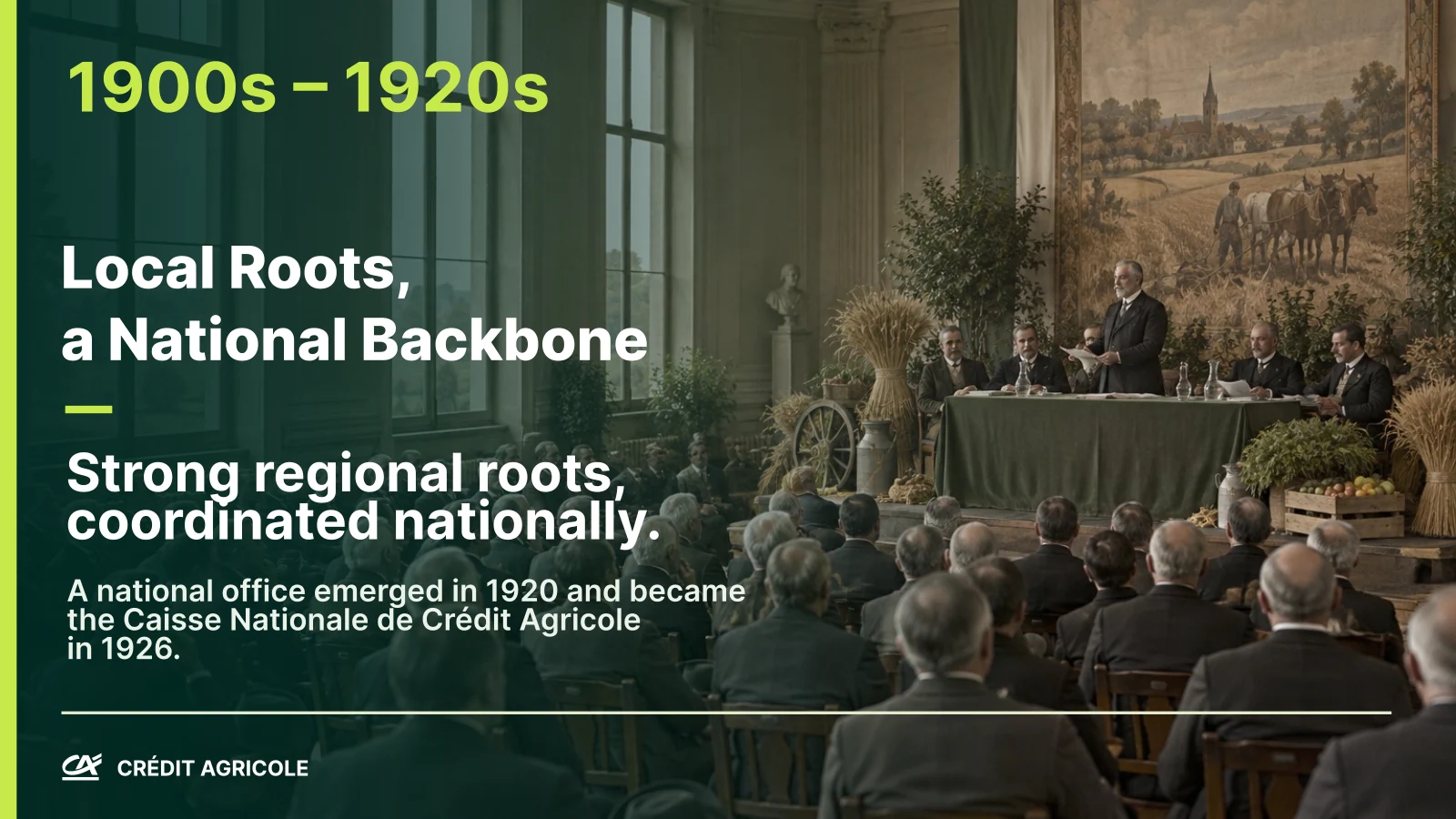
Welcome to your Crédit Agricole onboarding journey. This is chapter 3: Local Roots, a National Backbone. When an institution grows from one community into a network, it faces a new question. How do you keep the value of local knowledge while gaining the strength of a coordinated organisation?
In the early twentieth century, Crédit Agricole gradually broadened what it could finance. Agricultural cooperatives needed investment, not only short-term seasonal loans. Individual farmers needed longer periods to pay for productive assets. Rural communities also needed infrastructure and housing.
These new needs required a stronger institutional framework. In 1920, the Office National du Crédit Agricole was created as a central organisation. Six years later, it was renamed the Caisse Nationale de Crédit Agricole.
The central institution helped organise the network, while the regional and local foundations continued to matter. Over time, this made it possible to deliver a wider range of financial services to more people.
Notice the historical photographs and the simple organisational diagram. One tells a story of people meeting, negotiating and building trust. The other tells a story of how a network becomes capable of acting together.
The enduring idea is that proximity and scale need not be opposites. They can strengthen each other if responsibilities are clear. As a new colleague, consider what this moment teaches us about understanding customer needs, acting responsibly, and building trust. You can now explore the poster's three questions.
Practice the three questions1. What problem did a national coordinating organisation help solve?
How many local and regional entities could work effectively as one network.
How to remove every local relationship.
How to make farmers independent of any financing.
Show answer & explanation
A. How many local and regional entities could work effectively as one network. — National coordination helped the network grow while keeping its regional foundations.
2. Why did lending evolve beyond short-term seasonal loans?
Every loan could be repaid in a single day.
Customers needed finance for equipment, cooperatives and long-term improvement.
The original farms had stopped producing food.
Show answer & explanation
B. Customers needed finance for equipment, cooperatives and long-term improvement. — New agricultural and rural needs required different maturities and services.
3. Which combination best captures the early model?
Only central instructions and no local voice.
A purely international investment bank.
Local knowledge and shared organisational strength.
Show answer & explanation
C. Local knowledge and shared organisational strength. — The story is about building scale on top of local cooperation.
CHAPTER 04 · 1930s–1940s | Crisis, war and rebuilding
When Trust Was Tested
Welcome to your Crédit Agricole onboarding journey. This is chapter 4: When Trust Was Tested. A bank's values become most visible when circumstances are difficult.
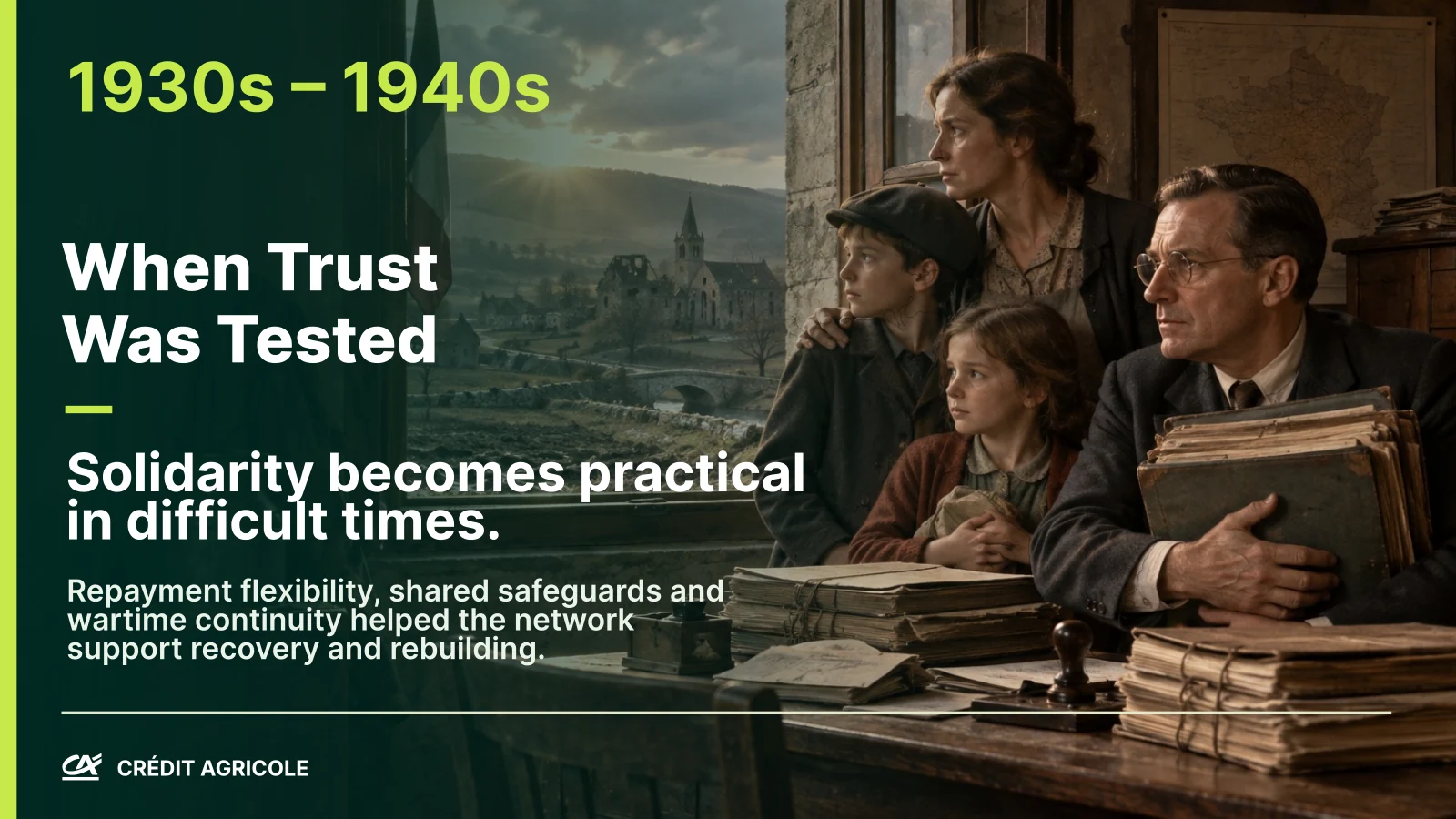
The economic crisis of the early 1930s hit agricultural prices, incomes and the ability of borrowers to repay. Crédit Agricole responded in part by allowing repayments to be spread over time. This was not a promise that loans carried no risk. It was an attempt to help viable farms survive without sacrificing the health of the banking network.
In 1935, the regional banks established a joint deposit-guarantee mechanism to strengthen mutual financial solidarity.
The Second World War brought an entirely different level of disruption. Some regional banks had to move or protect their records. The official Group archive tells the story of Louise Tallerie, who carried the accounting books of the Ardennes regional bank to safety. During the war, five-year notes launched in 1942 also helped finance reconstruction and modernisation.
Look closely at the advertisements here. They show that banking history is not only about laws and organisations. It is about communicating security, savings and the possibility of rebuilding.
The lasting lesson is that solidarity requires practical decisions: preserving information, adapting to customers' realities and protecting a financial institution's ability to serve them tomorrow. As a new colleague, consider what this moment teaches us about understanding customer needs, acting responsibly, and building trust. You can now explore the poster's three questions.
Practice the three questions1. Why might a bank extend repayments during a severe agricultural crisis?
Because credit risk disappears during a crisis.
Because loans are no longer financial commitments.
To help viable borrowers recover while managing risk.
Show answer & explanation
C. To help viable borrowers recover while managing risk. — Restructuring can protect both the customer relationship and the bank’s longer-term health.
2. What was the value of shared financial safeguards between regional banks?
They improved the network’s resilience to shocks.
They removed the need for prudent management.
They guaranteed that no institution could ever experience problems.
Show answer & explanation
A. They improved the network’s resilience to shocks. — Mutual safeguards support stability; they do not eliminate risk.
3. What does the story of protecting accounting records illustrate?
Banks have no need for records in an emergency.
Continuity of service depends on people, reliable information and organisation.
Paperwork is more important than all customers.
Show answer & explanation
B. Continuity of service depends on people, reliable information and organisation. — Operational continuity is a human and organisational responsibility.
CHAPTER 05 · 1950s–1970s | Wider access, new services
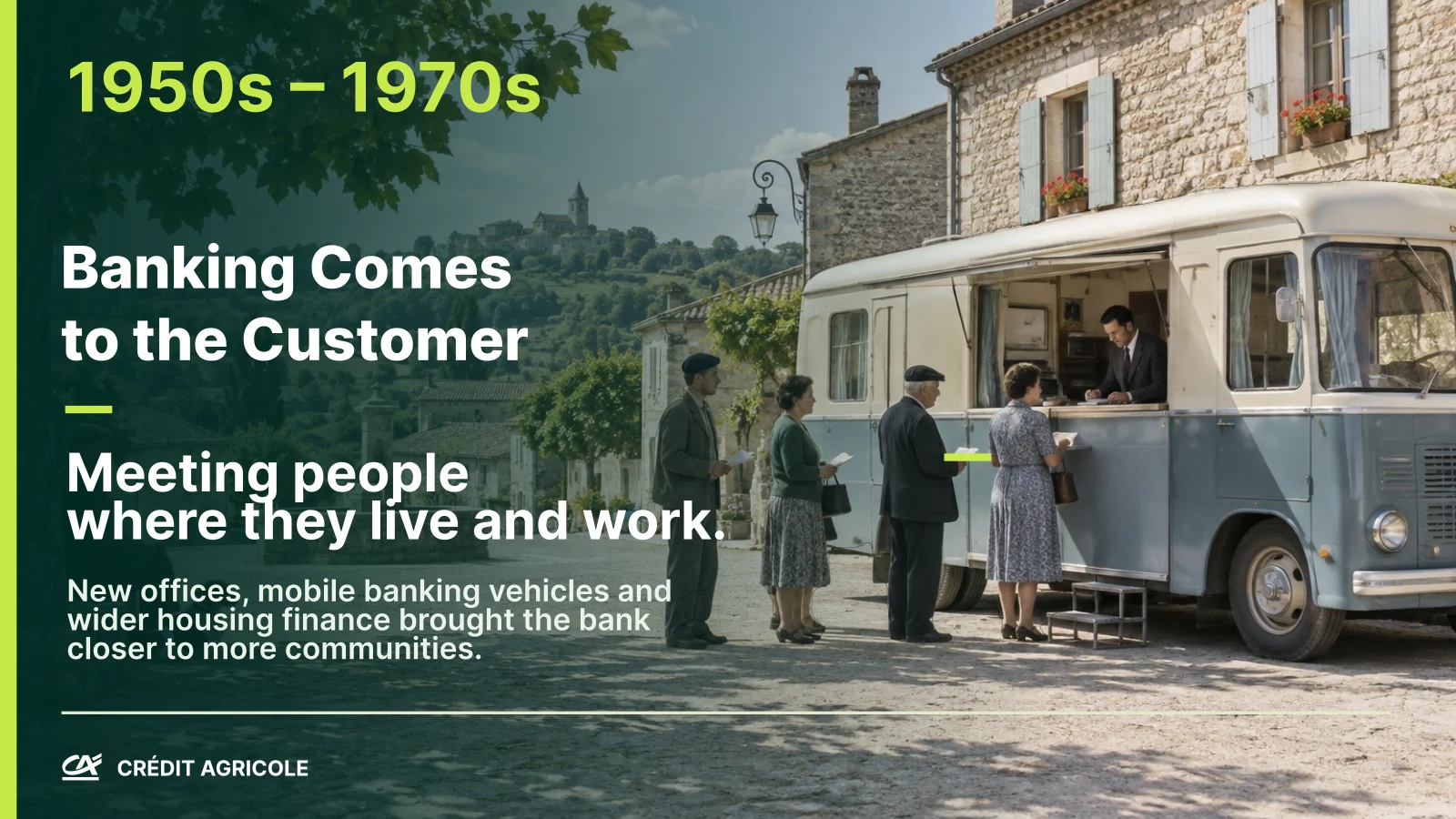
Banking Comes to the Customer
Welcome to your Crédit Agricole onboarding journey. This is chapter 5: Banking Comes to the Customer. For a long time, a local banking experience could be surprisingly informal. Some customers met representatives on market days. Others dealt with volunteers who managed local banking affairs alongside their other work.
As financial activity increased after the war, this model had to evolve. Crédit Agricole recruited more specialist staff, opened more offices and even used mobile banking vehicles to reach remote villages. The image of a bank travelling to its customers makes the principle of proximity very concrete.
At the same time, customer needs were changing. Farmers still needed equipment finance, but rural households increasingly needed access to savings, payments and housing loans. From 1959, Crédit Agricole could finance housing for people in rural areas, not only for farmers.
During the 1970s, its geographical reach extended towards the cities and its business scope widened further to small businesses, tradespeople and agri-food companies.
You may recognise a later slogan on this display: “Common sense close to home.” The idea behind it is older than the advertisement. A bank should be accessible in the places where people live and work.
This poster shows the transformation from a specialised agricultural lender into a broader relationship bank. As a new colleague, consider what this moment teaches us about understanding customer needs, acting responsibly, and building trust. You can now explore the poster's three questions.
Practice the three questions1. What do the mobile banking vehicles demonstrate?
Banking should only take place in headquarters.
Proximity can be achieved by adapting delivery to customers’ circumstances.
All customers prefer to travel long distances to find a bank.
Show answer & explanation
B. Proximity can be achieved by adapting delivery to customers’ circumstances. — The service model changed to make access easier.
2. Why was financing rural housing a meaningful expansion?
It meant agricultural customers could no longer borrow.
It turned all regional banks into construction companies.
The bank began meeting wider household needs beyond farming.
Show answer & explanation
C. The bank began meeting wider household needs beyond farming. — The target population expanded while maintaining a connection to local communities.
3. What links the 1950s outreach and the later advertising slogan?
A lasting commitment to close customer relationships.
A decision to end face-to-face service.
An emphasis on serving only the largest companies.
Show answer & explanation
A. A lasting commitment to close customer relationships. — The historic idea of closeness persisted through changing channels and products.
CHAPTER 06 · 1980s–2001 | Becoming a universal bank
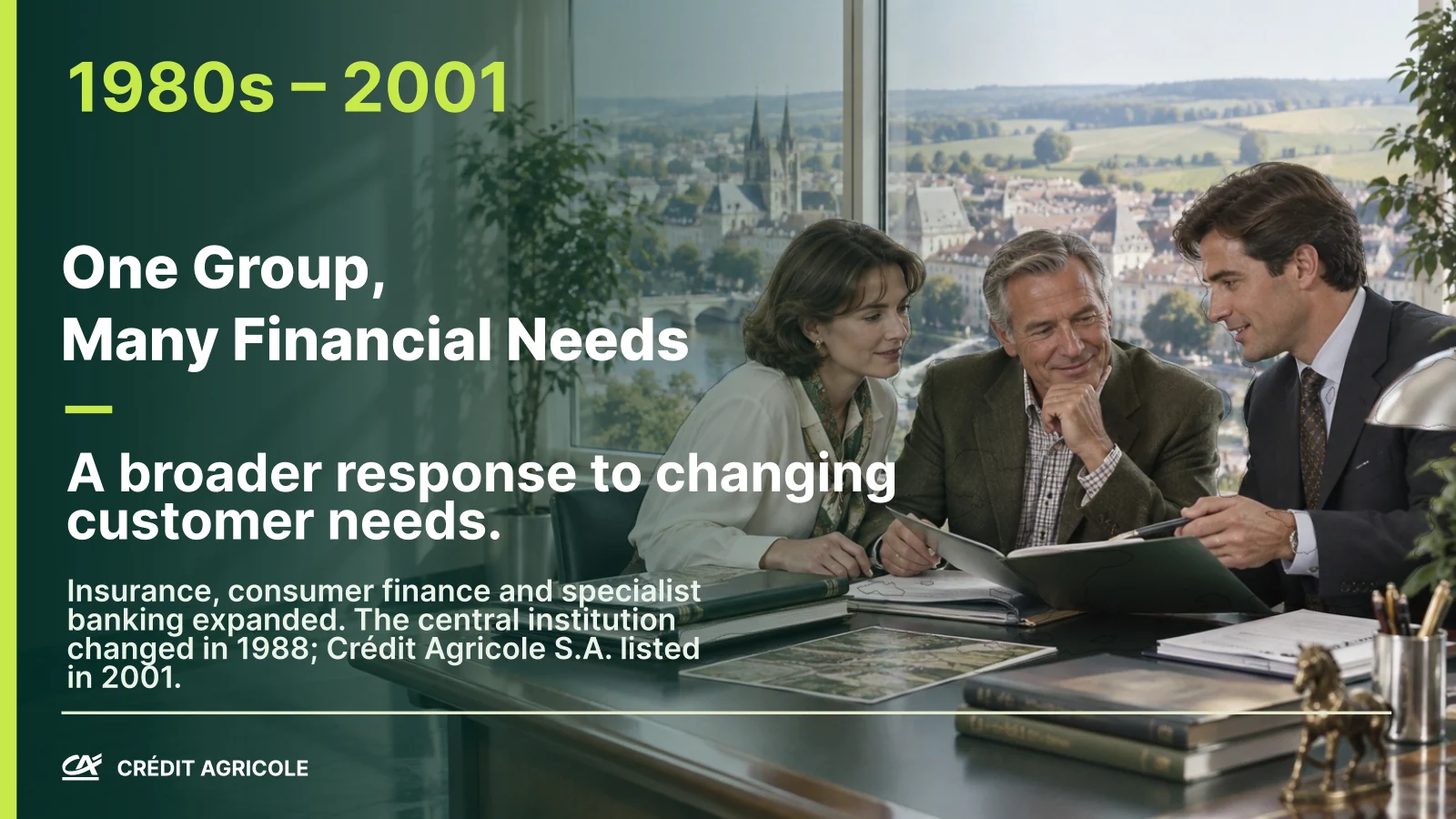
One Group, Many Financial Needs
Welcome to your Crédit Agricole onboarding journey. This is chapter 6: One Group, Many Financial Needs. By the 1980s, Crédit Agricole had travelled far from the first agricultural loans. It could now operate across France, serve a wide range of households and businesses, and develop more specialised expertise.
What does universal banking mean? In simple terms, it means helping customers with different kinds of financial needs over time: everyday accounts, savings, borrowing, insurance, business financing and more complex services.
The Group expanded its capabilities partly by building new businesses, including the life-insurance company Predica. Later, acquisitions such as Banque Indosuez and Sofinco added investment-banking and consumer-finance expertise.
Its institutional structure also changed. In 1988, a major reform allowed the regional banks to take ownership of the national central institution. In 2001, Crédit Agricole S.A. was listed on the stock market.
The two images here tell different stories. Advertising shows how customer needs and services were changing. The listing-era visual marks a change in the scale and financial organisation of the Group.
Yet diversification was not a replacement for the original purpose. It was a way to answer a much wider set of customer needs. The question remained: what can this bank help people and businesses do? As a new colleague, consider what this moment teaches us about understanding customer needs, acting responsibly, and building trust. You can now explore the poster's three questions.
Practice the three questions1. What makes a bank “universal” in this historical context?
It can support many customer segments and financial needs.
It offers only one agricultural loan product.
It has no specialised expertise.
Show answer & explanation
A. It can support many customer segments and financial needs. — Universal banking combines a broad relationship with multiple financial capabilities.
2. Why would acquiring specialist financial businesses be useful?
It removes all regulatory obligations.
It adds capabilities customers already need, such as insurance or investment banking.
It means the bank no longer needs customers.
Show answer & explanation
B. It adds capabilities customers already need, such as insurance or investment banking. — Specialist businesses complement the relationship network.
3. What is the best way to interpret diversification?
As evidence that its original history never mattered.
As proof that cooperative participation ceased to exist.
As an expansion of how the Group can serve customers.
Show answer & explanation
C. As an expansion of how the Group can serve customers. — The original purpose and expanded services can coexist.
CHAPTER 07 · 1863 / 2003–2005 | Crédit Lyonnais joins the Group
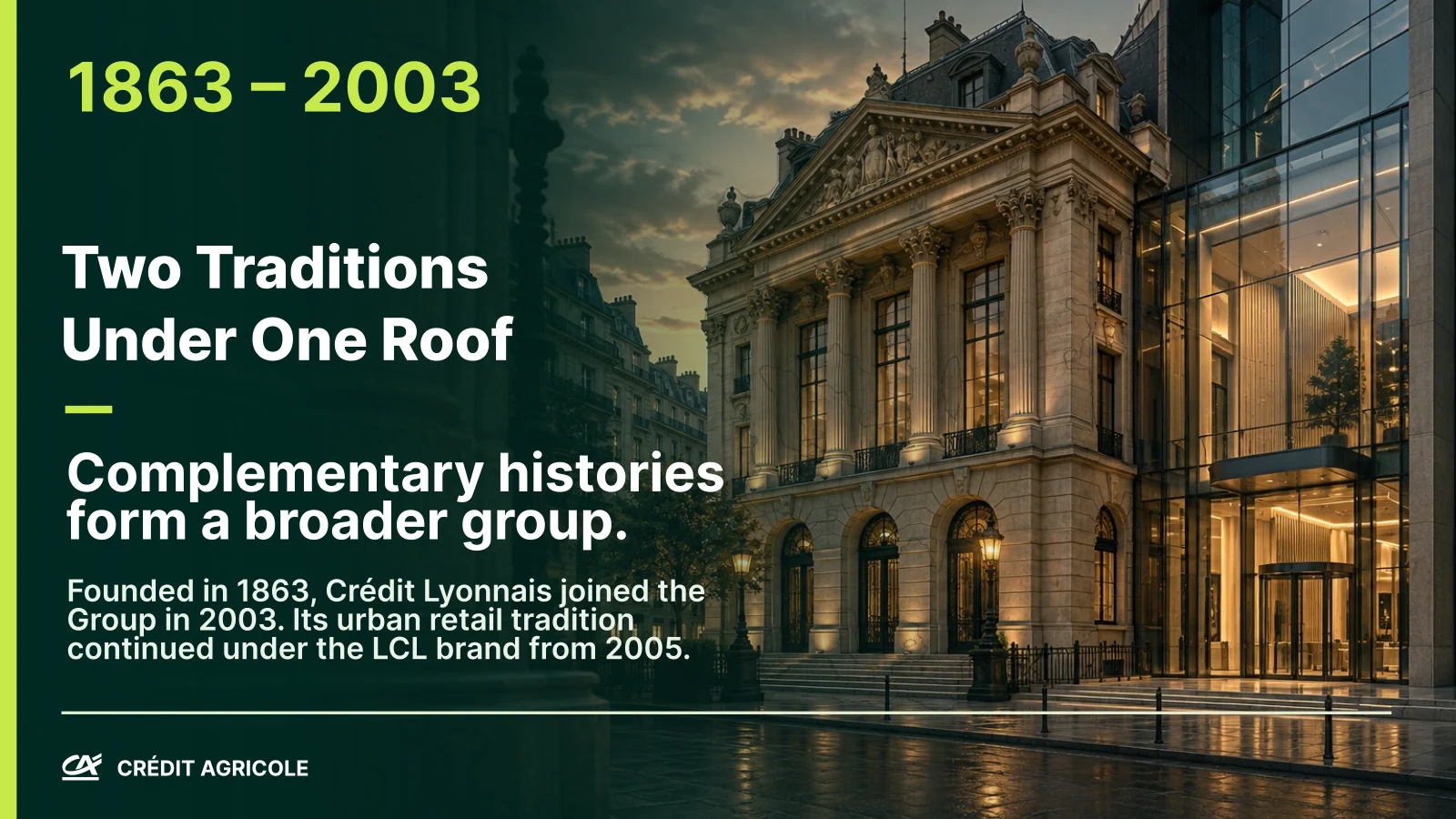
Two Traditions Under One Roof
Welcome to your Crédit Agricole onboarding journey. This is chapter 7: Two Traditions Under One Roof. This poster introduces a second historical journey.
Crédit Lyonnais was founded in Lyon in 1863, more than twenty years before the first Crédit Agricole local bank. It developed a prominent banking presence in towns and cities, while Crédit Agricole's original strengths were linked to agricultural and regional communities.
The difference matters. A banking group can grow by offering more services to existing customers, but it can also grow by reaching customers whom its current network serves less well.
The tie-up with Crédit Lyonnais in 2003 brought together two strong French banking traditions. It also made it possible to combine specialist business lines. The Crédit Lyonnais retail operation adopted the LCL brand in 2005.
The portrait here is of Henri Germain, founder of Crédit Lyonnais, not founder of Crédit Agricole. The historical photograph shows the older brand; the modern LCL sign shows its later identity.
Instead of seeing this merger as the disappearance of one history, think of it as a meeting of complementary strengths. Different origins, different customer profiles and different areas of expertise could now contribute to a much broader Group. As a new colleague, consider what this moment teaches us about understanding customer needs, acting responsibly, and building trust. You can now explore the poster's three questions.
Practice the three questions1. Why was the Crédit Lyonnais combination strategically valuable?
It required the Group to stop rural banking.
It eliminated the need for different retail brands.
It brought complementary urban retail relationships and expertise.
Show answer & explanation
C. It brought complementary urban retail relationships and expertise. — The networks had different historical strengths and customer reach.
2. What does the continued LCL brand illustrate?
A Group can combine capabilities while keeping distinct customer-facing identities.
Every subsidiary must have exactly the same name.
A merger always removes all existing brands immediately.
Show answer & explanation
A. A Group can combine capabilities while keeping distinct customer-facing identities. — Integration and brand differentiation can happen together.
3. How should Henri Germain be identified on this poster?
As the inventor of agricultural machinery.
As the founder of Crédit Lyonnais.
As the founder of the first Crédit Agricole local bank.
Show answer & explanation
B. As the founder of Crédit Lyonnais. — He founded Crédit Lyonnais, an institution whose history later joined the Group.
CHAPTER 08 · 1979–today | International ties and Ukrainian roots
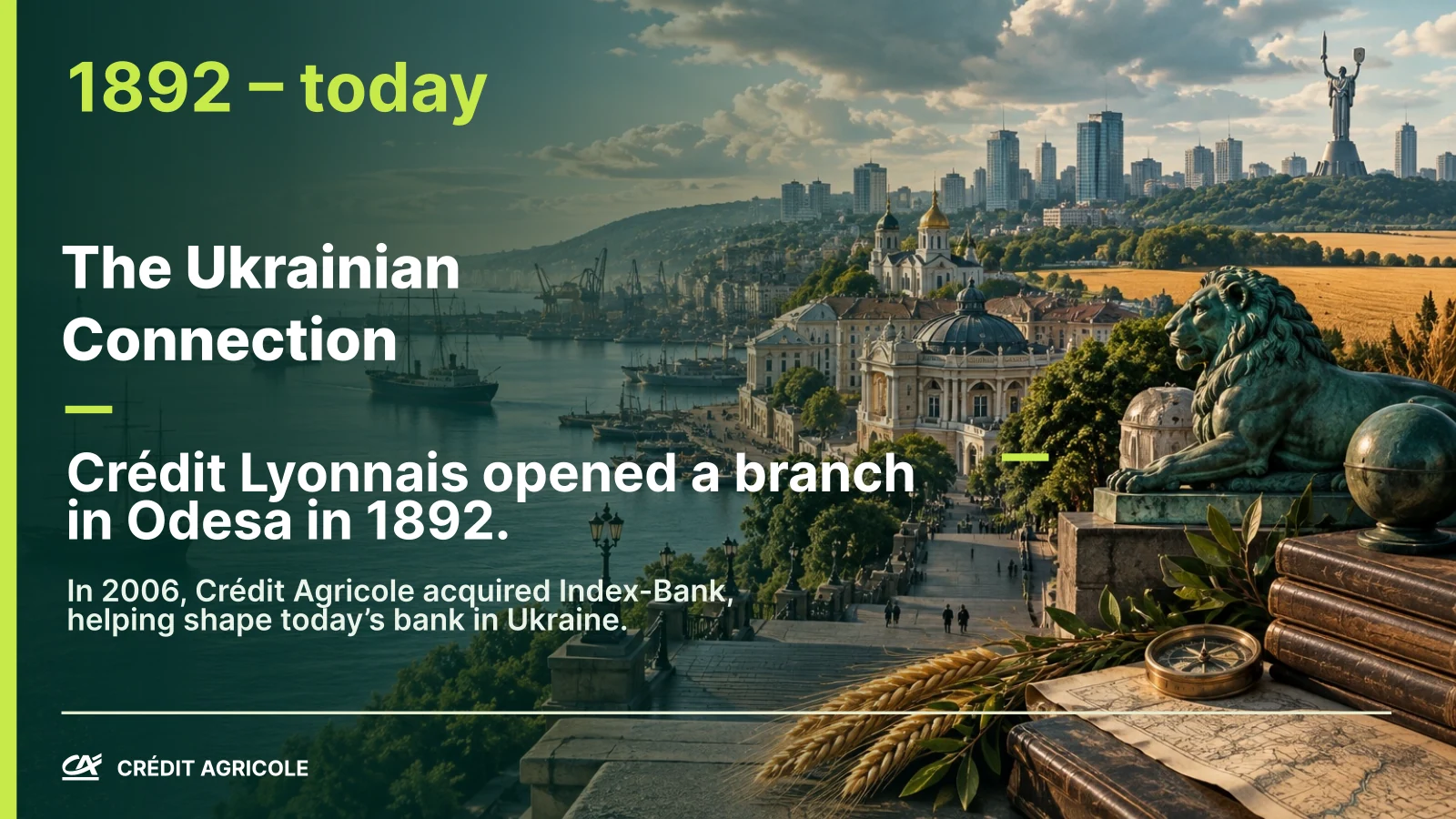
From France to Ukraine: A Connected Story
Welcome to your Crédit Agricole onboarding journey. This is chapter 8: From France to Ukraine: A Connected Story. International expansion often begins with an existing customer relationship. In 1979, Crédit Agricole opened a representative office in Chicago, an important centre for agricultural commodities. The aim was to support customers who were already doing business across borders.
Ukraine's connection to the Group involves another historical path. Crédit Lyonnais opened a branch in Odesa in 1892. Much later, in 1993, Crédit Lyonnais established a bank in Kyiv. Following the integration of Crédit Lyonnais into Crédit Agricole Group, the Group also acquired Ukraine's Index-Bank in 2006.
These developments brought together international corporate banking experience and a wider local retail network. They help explain why the Ukrainian bank today combines the capabilities of an international group with knowledge of its own market.
The world map on the wall comes from a 2017 training presentation. It is a historical snapshot, not a live map of the Group's present footprint.
What connects this story to the very first poster? Finance follows people, trade and production. A bank that began by understanding farmers in one French region later developed ways to support businesses and households across countries. In Ukraine, that history became part of a local institution's identity. As a new colleague, consider what this moment teaches us about understanding customer needs, acting responsibly, and building trust. You can now explore the poster's three questions.
Practice the three questions1. What is a strong reason for a bank to develop an international presence?
To remove the importance of local market knowledge.
To support customers whose financial activities extend across borders.
To guarantee identical customer needs in every country.
Show answer & explanation
B. To support customers whose financial activities extend across borders. — Cross-border relationships drive international banking, but local knowledge remains important.
2. Which two strands helped shape Crédit Agricole Bank in Ukraine?
Only the 1976 French advertising campaign.
Only the creation of the first Jura cooperative.
Crédit Lyonnais banking roots and the acquisition of Index-Bank.
Show answer & explanation
C. Crédit Lyonnais banking roots and the acquisition of Index-Bank. — The Ukrainian story reflects the convergence of international corporate and local retail traditions.
3. Why is the 2017 global map labelled as historical?
Because geographic presence and figures change over time.
Because maps are never useful for banks.
Because every country shown was a Ukrainian branch.
Show answer & explanation
A. Because geographic presence and figures change over time. — Historical maps should not be mistaken for current operational data.
CHAPTER 09 · 2019–today | From history to the next chapter
A Purpose That Travels Forward
Welcome to your Crédit Agricole onboarding journey. This is chapter 9: A Purpose That Travels Forward. At the beginning of this exhibition, we asked why Crédit Agricole was created. The answer was practical: a community needed financing that understood its circumstances.
Over time, the institution changed dramatically. It built a network, survived crises, expanded its services, combined banking traditions and developed an international presence. Yet one theme keeps returning: the relationship between finance and the people who depend on it.
In 2019, the Group formally expressed its purpose as follows: “Working every day in the interest of our customers and society.”
This is a commitment rather than a historical achievement that can simply be filed away. It asks how banking decisions affect customers, colleagues, communities and the long-term economy. The Group describes its model through customer relationships, the role of employees and wider social responsibility.
In Ukraine, these questions are especially concrete. The bank continues to support customers, including agribusiness and companies, while adapting its services and operating through wartime.
The history room ends here, but the onboarding story does not. The next chapter is about the bank today: who it serves, what it offers, how it works and what each colleague contributes to the customer experience. As a new colleague, consider what this moment teaches us about understanding customer needs, acting responsibly, and building trust. You can now explore the poster's three questions.
Practice the three questions1. What links the 1885 beginnings to the 2019 purpose statement?
A focus on serving real customer and societal needs.
A commitment to offer only agricultural short-term loans.
A belief that banking should avoid changing with society.
Show answer & explanation
A. A focus on serving real customer and societal needs. — The original local purpose is carried into a broader modern mission.
2. How should employees understand the purpose statement?
As a substitute for compliance and risk management.
As a guide to daily decisions and relationships, not just a slogan.
As a claim that every decision is automatically perfect.
Show answer & explanation
B. As a guide to daily decisions and relationships, not just a slogan. — Purpose needs to be translated into responsible action, customer care and sound decisions.
3. What is the best next question after finishing the history room?
Which historical advertisement is the largest?
How can we memorise every acquisition year?
How do the Group’s values and the Ukrainian bank’s capabilities show up in our work today?
Show answer & explanation
C. How do the Group’s values and the Ukrainian bank’s capabilities show up in our work today? — The next onboarding chapter should connect historical identity to present-day behaviours.
Research-based onboarding concept. The supplied graphic posters contain conceptual/AI-assisted historical imagery and may reproduce archival previews. This is not official compliance training or an approved use of Crédit Agricole brand assets. Please verify factual wording and archival reuse rights before corporate publication. Narration is local CPU-generated synthetic English speech, not a recording of a human guide.