CRÉDIT AGRICOLE / HERITAGE
CURATOR'S IMPLEMENTATION GUIDE · RESEARCH-BASED CONCEPT

140 years.
One living story.

A historically grounded induction experience. Explore the milestones, their placement in the digital gallery, the original illustrations, and the learning objectives behind each moment.

1885—2025HISTORICAL PERIOD
12CURATED WALL CHAPTERS
10LEARNING QUESTIONS
3ORIGINAL VIDEO MONTAGES
ENTER THE 3D EXPERIENCE ↗
GALLERY 01 / HISTORICAL TIMELINE

Milestones worth remembering.

Follow the original museum wall panels from the Jura beginnings, through cooperative growth, to universal banking and purpose today. Every panel links to Crédit Agricole’s own historical archive. The artwork is newly created illustration, not claimed historical photography.

Original modern illustration symbolising 1885; not an archival photograph
CHAPTER 01 / Heritage Hall · East wall

1885 The First Local Bank

In Salins-les-Bains, Jura, farmers lacked accessible financing. Local entrepreneurs Alfred Bouvet and Louis Milcent created a bank designed around their needs. This practical, community-minded beginning shaped the Group’s identity.

WHY IT MATTERS TO NEW JOINERS

The starting question was never “how big can we become?” It was “what do our communities need?”
Check the official archive source ↗
Original modern illustration symbolising 1894; not an archival photograph
CHAPTER 02 / Heritage Hall · East wall

1894 A Cooperative Movement

The law of 5 November 1894 encouraged cooperative local banks across France. Members could join forces to finance agricultural needs. Crédit Agricole’s bottom-up structure grew from these locally rooted institutions.

WHY IT MATTERS TO NEW JOINERS

The cooperative model matters because listening to members and understanding territories remains part of the Group’s DNA.

Check the official archive source ↗
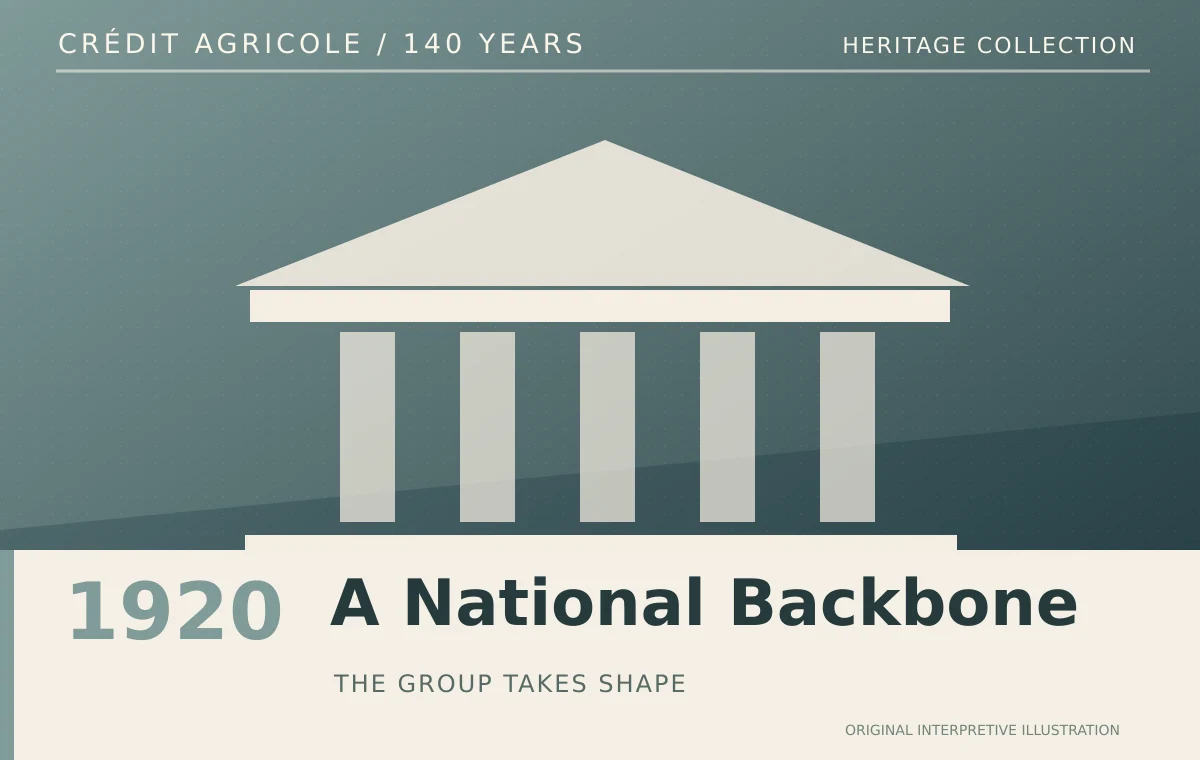
Original modern illustration symbolising 1920; not an archival photograph
CHAPTER 03 / Heritage Hall · East wall

1920 A National Backbone

The Office National du Crédit Agricole was established in 1920 to coordinate regional banks and financing. Renamed the Caisse Nationale in 1926, it became the central institution in a system built on local and regional cooperative banks.

WHY IT MATTERS TO NEW JOINERS

This explains a distinctive organisation: local relationships supported by a coordinated national structure.

Check the official archive source ↗
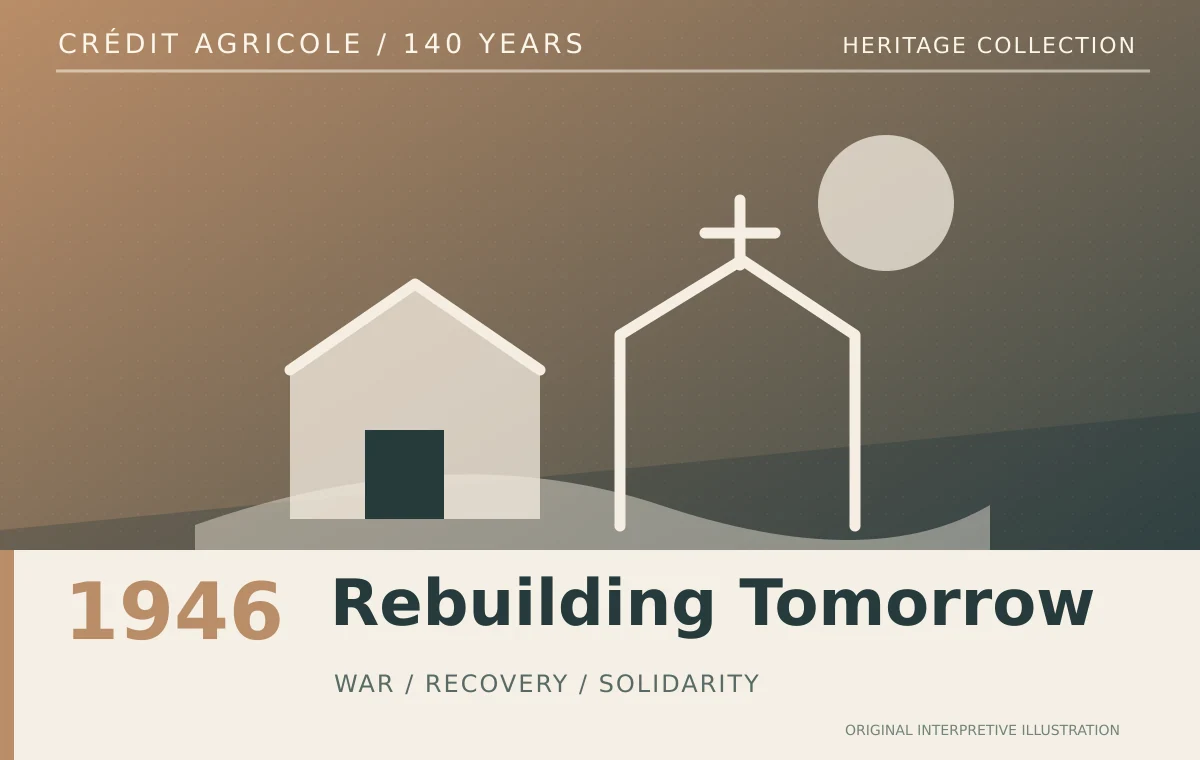
Original modern illustration symbolising 1946; not an archival photograph
CHAPTER 04 / Heritage Hall · East wall

1946 Rebuilding Tomorrow

During wartime, Crédit Agricole continued to adapt. Five-year notes introduced in 1942 helped finance loans for reconstruction and farm modernisation. From 1946, preferential-rate loans also supported young farmers starting their businesses.

WHY IT MATTERS TO NEW JOINERS

A bank’s resilience is meaningful when it helps customers build again after disruption.

Check the official archive source ↗
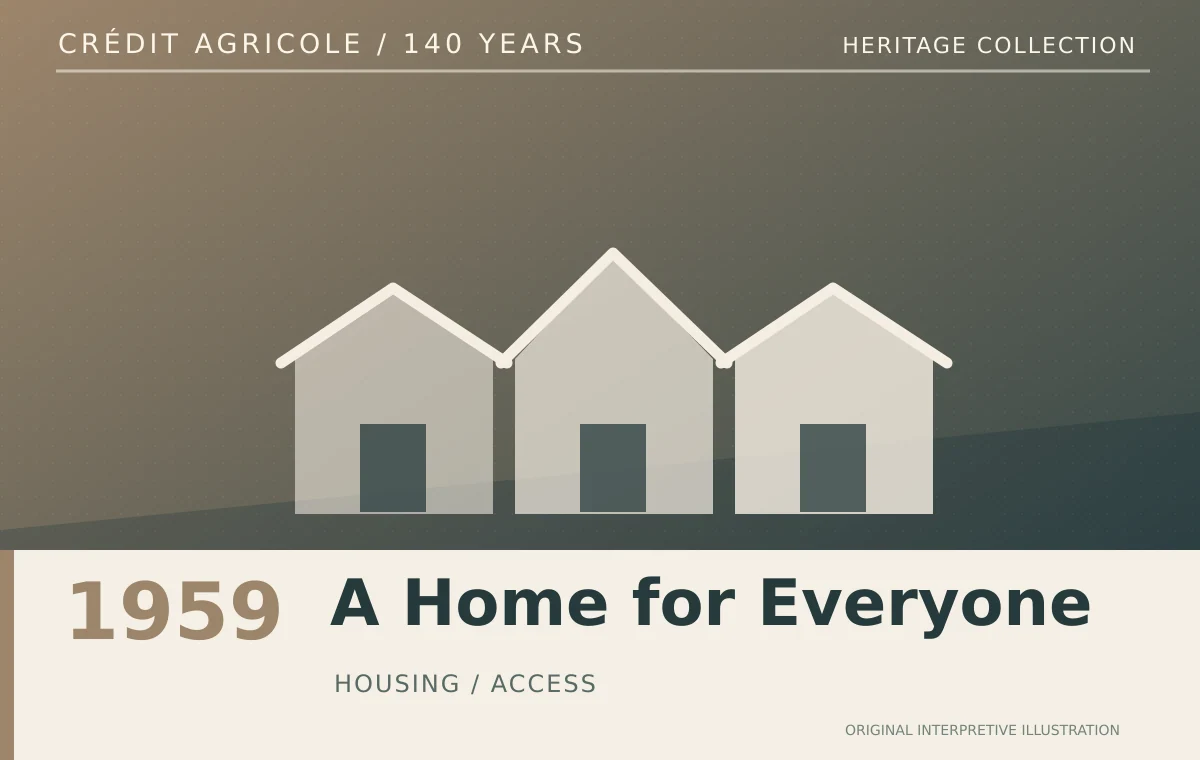
Original modern illustration symbolising 1959; not an archival photograph
CHAPTER 05 / The Commons · West gallery

1959 A Home for Everyone

After expanding its network and services through the 1950s, Crédit Agricole gained the ability in 1959 to finance homes for all rural residents—not only farmers. This broadened the meaning of serving a community.

WHY IT MATTERS TO NEW JOINERS

Understanding clients’ changing life needs is what turns a specialised institution into a trusted everyday partner.

Check the official archive source ↗
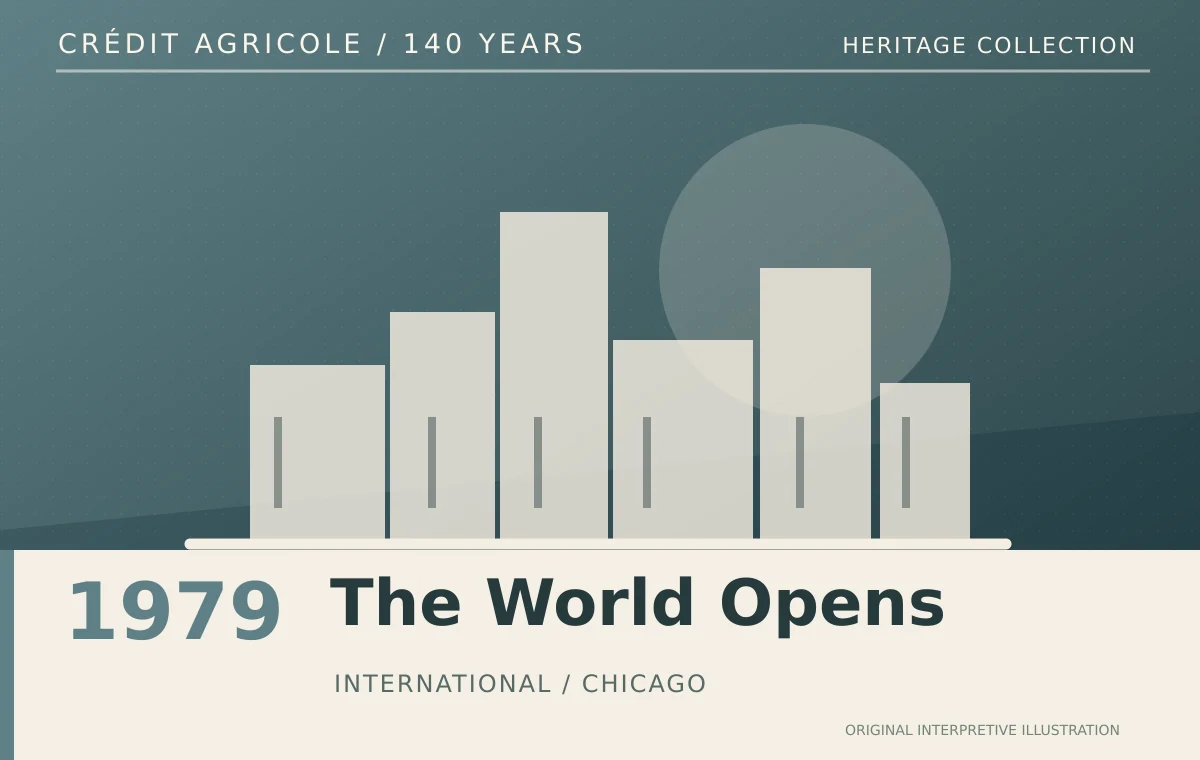
Original modern illustration symbolising 1979; not an archival photograph
CHAPTER 06 / The Commons · West gallery

1979 The World Opens

As the Group expanded from rural France into cities and to SMEs, it also followed customers abroad. A representative office opened in Chicago in 1979 to help regional-bank customers participate in international agricultural markets.

WHY IT MATTERS TO NEW JOINERS

Geographical expansion was not an end in itself: it helped customers reach new markets.

Check the official archive source ↗
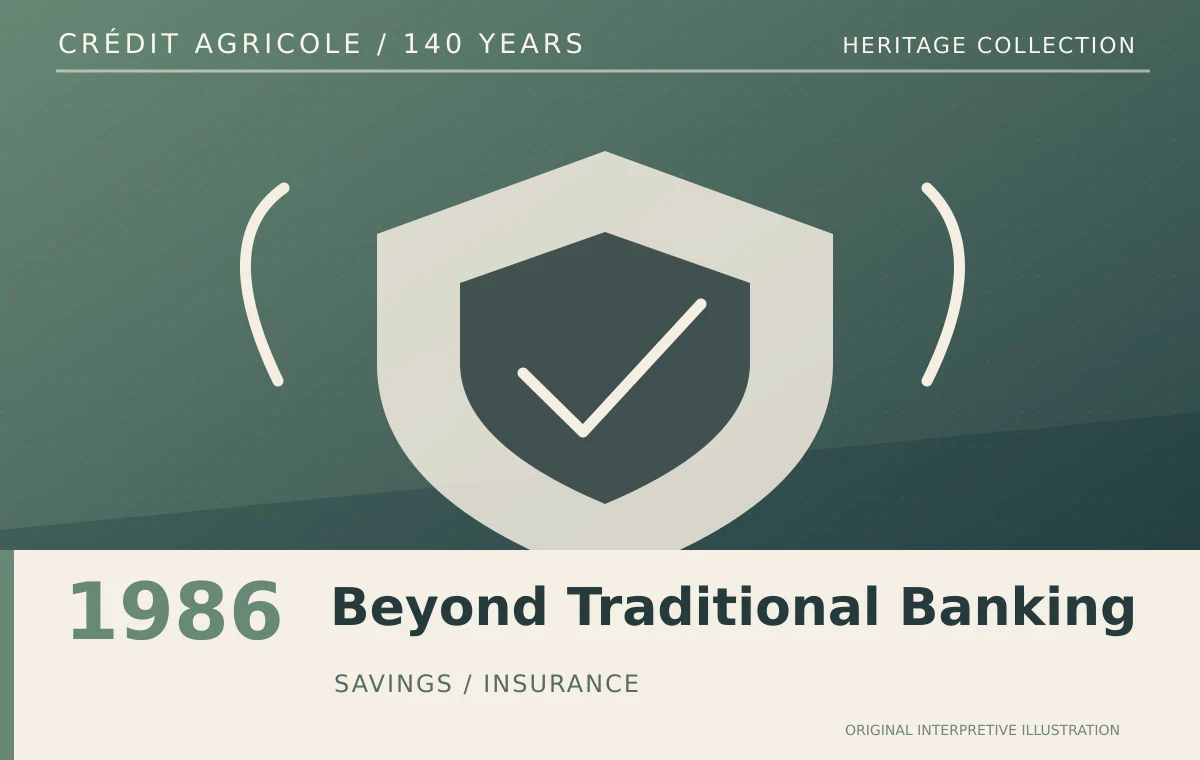
Original modern illustration symbolising 1986; not an archival photograph
CHAPTER 07 / The Commons · West gallery

1986 Beyond Traditional Banking

The creation of Predica in 1986 moved Crédit Agricole into life insurance, building on its customers’ savings and protection needs. This marked an important step toward its later strength in bancassurance.

WHY IT MATTERS TO NEW JOINERS

A universal relationship is built by addressing savings, financing and protection together.

Check the official archive source ↗
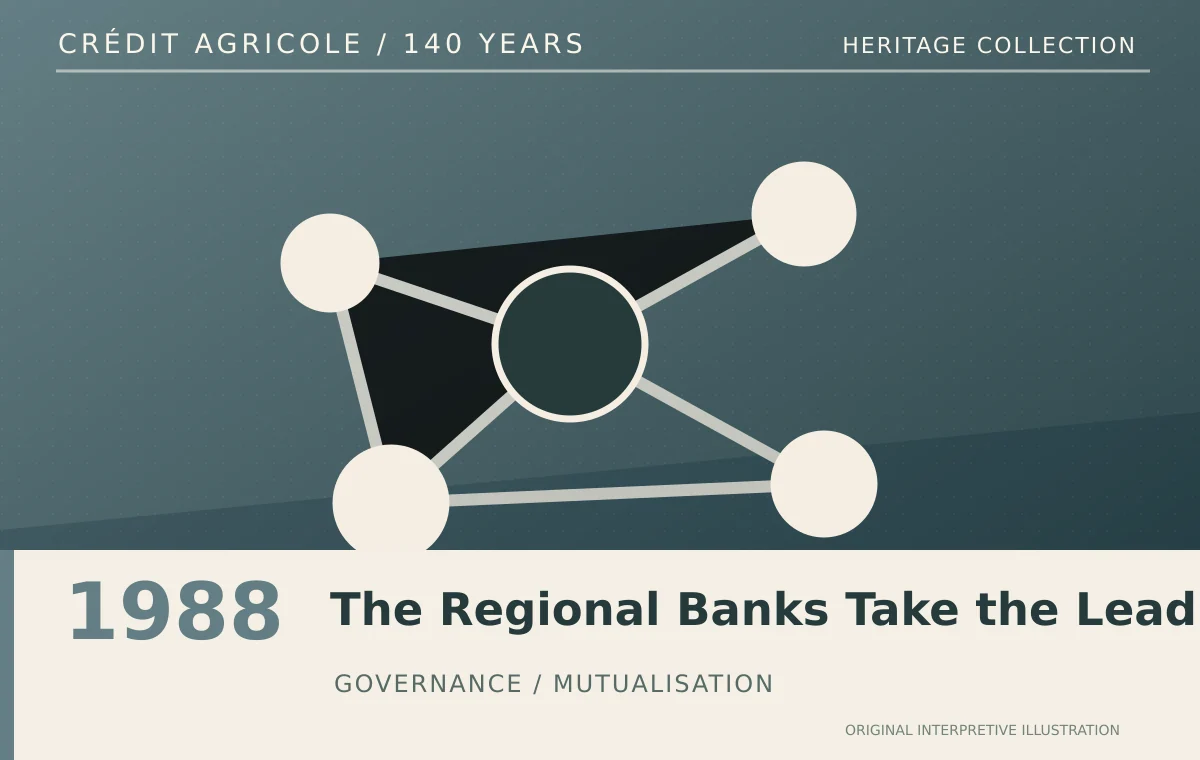
Original modern illustration symbolising 1988; not an archival photograph
CHAPTER 08 / Creative Studio · North gallery

1988 The Regional Banks Take the Lead

In 1988, the Caisse Nationale was transformed from a state-controlled public establishment into a company with its capital largely held by the Regional Banks. This pivotal mutualisation reinforced the Group’s cooperative ownership structure.

WHY IT MATTERS TO NEW JOINERS

Knowing who owns and governs the central institution explains how local roots connect to Group-wide decisions.

Check the official archive source ↗
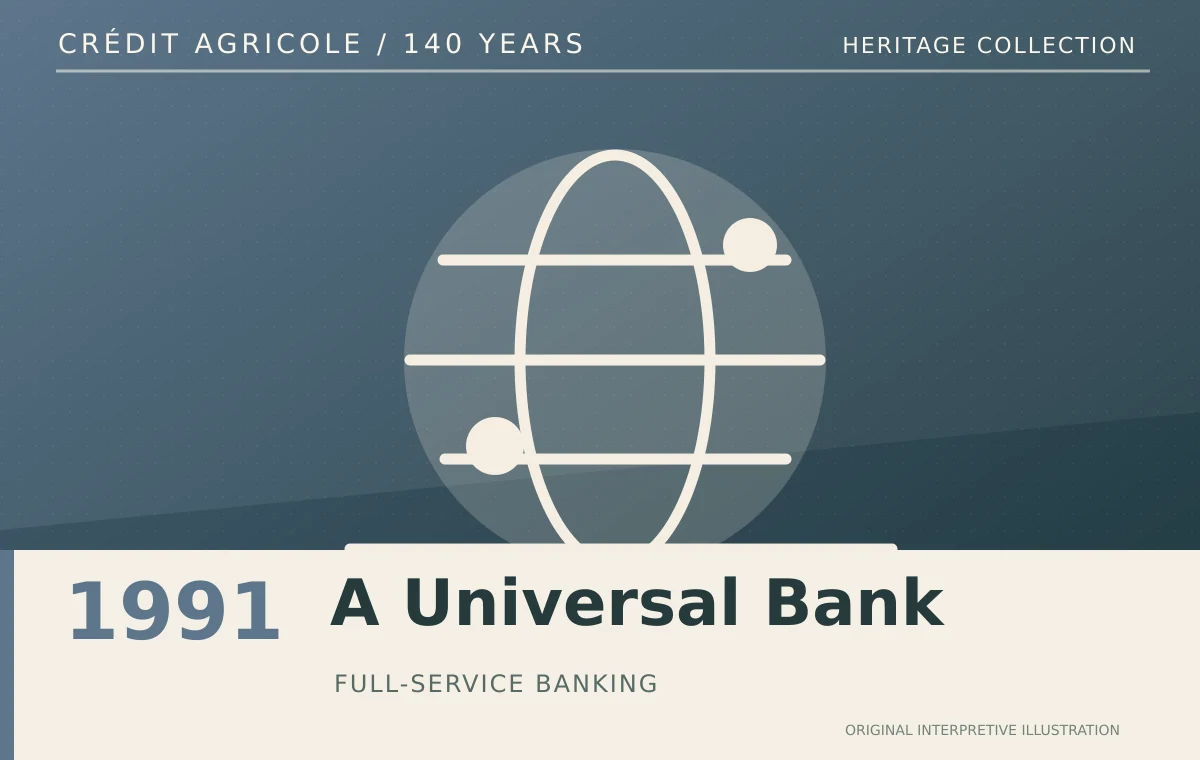
Original modern illustration symbolising 1991; not an archival photograph
CHAPTER 09 / Creative Studio · North gallery

1991 A Universal Bank

By 1991, the last restrictions on corporate and investment banking were lifted. Crédit Agricole could serve households, professionals, businesses and diverse economic sectors as a universal bank.

WHY IT MATTERS TO NEW JOINERS

Today’s many specialised businesses make sense when viewed as parts of a broader customer relationship.

Check the official archive source ↗
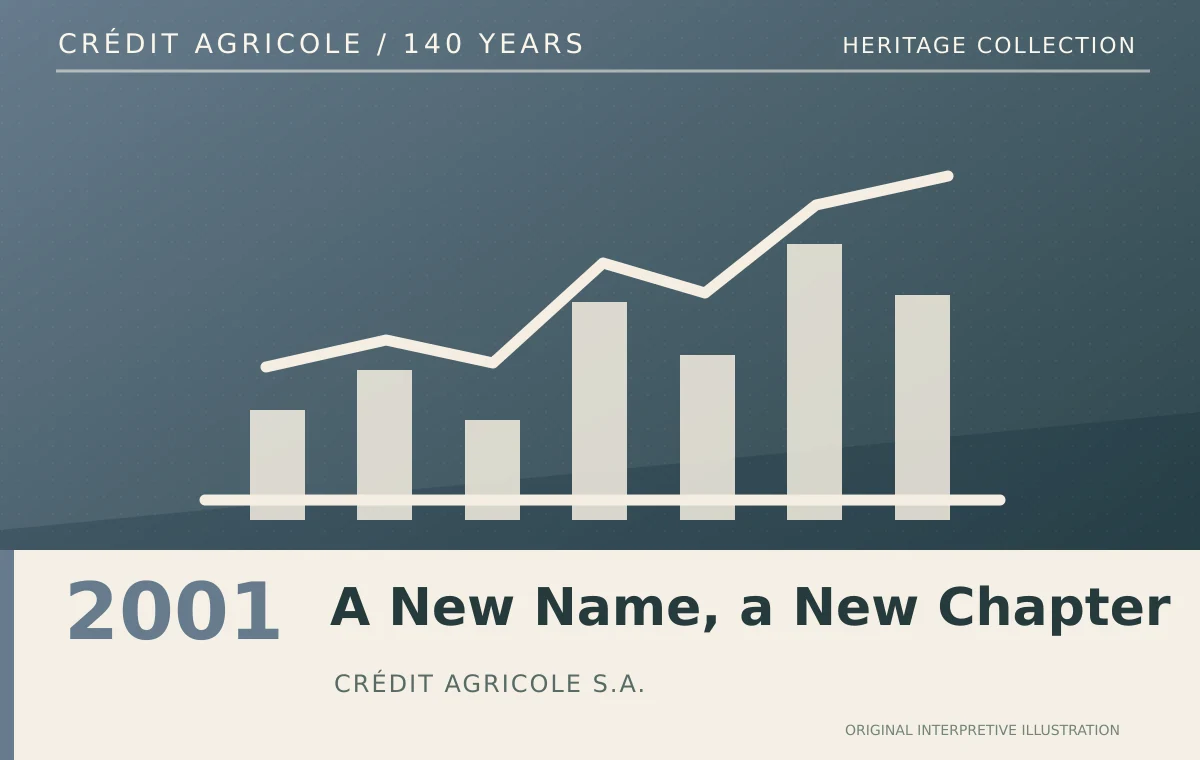
Original modern illustration symbolising 2001; not an archival photograph
CHAPTER 10 / Creative Studio · North gallery

2001 A New Name, a New Chapter

In December 2001, the central entity entered the stock market and adopted the name Crédit Agricole S.A. The Regional Banks retained their central role in its ownership, while the Group embarked on a new phase of development.

WHY IT MATTERS TO NEW JOINERS

Crédit Agricole Group and Crédit Agricole S.A. are connected but are not interchangeable: understanding that distinction is a useful first step.

Check the official archive source ↗
Original modern illustration symbolising 2019; not an archival photograph
CHAPTER 11 / Future Lab · South gallery

2019 A Purpose for Every Day

In 2019 the Group articulated its raison d’être: “Working every day in the interest of our customers and society.” Its Customer, Human-Centric and Societal Projects translate that purpose into concrete ambitions.

WHY IT MATTERS TO NEW JOINERS

Each role—whether customer-facing, technical or operational—can help turn this purpose into real decisions.

Check the official archive source ↗
Original modern illustration symbolising 2025; not an archival photograph
CHAPTER 12 / Future Lab · South gallery

2025 140 Years, One Living Story

At its 140-year milestone in 2025, Crédit Agricole described a model combining deeply rooted relationship banks with expert business lines. The Group now reports approximately 160,000 employees worldwide; its guiding principle remains service to customers and society.

WHY IT MATTERS TO NEW JOINERS

Your chapter begins here. Which need, customer or community will your work help serve?

Check the official archive source ↗
GALLERY 02 / INTERACTIVE LAPTOPS

Learn it. Connect it.

LAPTOP / A: HISTORY ESSENTIALS

Know the milestones.

  1. Where was the first Crédit Agricole local bank created in 1885?

    Correct answer: Salins-les-Bains in the Jura

    The first local bank began in Salins-les-Bains, Jura. · source
  2. Who helped establish that first local bank?

    Correct answer: Alfred Bouvet and Louis Milcent

    Alfred Bouvet and Louis Milcent responded to farmers’ financing needs. · source
  3. What did the law of 5 November 1894 enable?

    Correct answer: Cooperative local agricultural-credit banks

    It encouraged the spread of mutual, cooperative local banks. · source
  4. What was created in 1920?

    Correct answer: The Office National du Crédit Agricole

    It became the national coordinating institution, renamed in 1926. · source
  5. Which important activity expanded in 1959?

    Correct answer: Housing loans for all rural residents

    From 1959, rural housing finance was no longer limited to farmers. · source
  6. What milestone marked the move beyond France in 1979?

    Correct answer: A Chicago representative office

    The Chicago office helped regional-bank customers reach international agricultural markets. · source
LAPTOP / B: PURPOSE IN PRACTICE

Connect history to your role.

  1. A client says the Group “only finances farming”. What is the best historically grounded response?

    Correct answer: It began in agriculture and evolved into universal banking to meet broader needs.

    Agricultural roots and universal banking are connected by a history of expanding usefulness. · source
  2. A teammate asks why Regional Banks matter to the Group. Which answer best reflects its history?

    Correct answer: They represent the cooperative/local foundations and became majority owners of the central institution.

    The bottom-up model and the 1988 mutualisation make Regional Banks central. · source
  3. Which choice most clearly connects the 2019 raison d’être to your work?

    Correct answer: Consider customers and society when making professional decisions.

    The declared purpose is to work in the interest of customers and society. · source
  4. A newcomer mixes up 1885 and 2001. Which distinction is right?

    Correct answer: The Group began locally in 1885; Crédit Agricole S.A. adopted its name and was listed in 2001.

    1885 marks the roots of the Group; 2001 marks a later milestone of the central institution. · source
GALLERY 03 / CINEMA

A story in motion.

The main projector loops a locally hosted, muted illustrated film. Two TVs show earlier and later chapters. They feature original interpretive art and verified captions—not archival footage or third-party film clips.

BEAMER / 36 SEC

140 Years of Being Useful

An original, silent 140-year illustrated history montage assembled from the source-backed gallery milestones. It is interpretive artwork, not archival film footage.

Watch film ↗
LEFT TV / 18 SEC

From Roots to Recovery

An illustrated film covering the local cooperative beginnings, a national framework, and post-war renewal.

Watch film ↗
RIGHT TV / 18 SEC

From Local to Universal

An illustrated film about expansion beyond farming, cooperative governance, universal banking, and purpose.

Watch film ↗

Editorial and training concept built from official archive research, not an authorised Crédit Agricole training product. The 12 visuals are newly drawn illustrations, and the silent movie is newly composed. Historical claims have links to their original sources. The complete implementation mapping, quiz answer key and maintenance details are also available as Markdown content pack.